

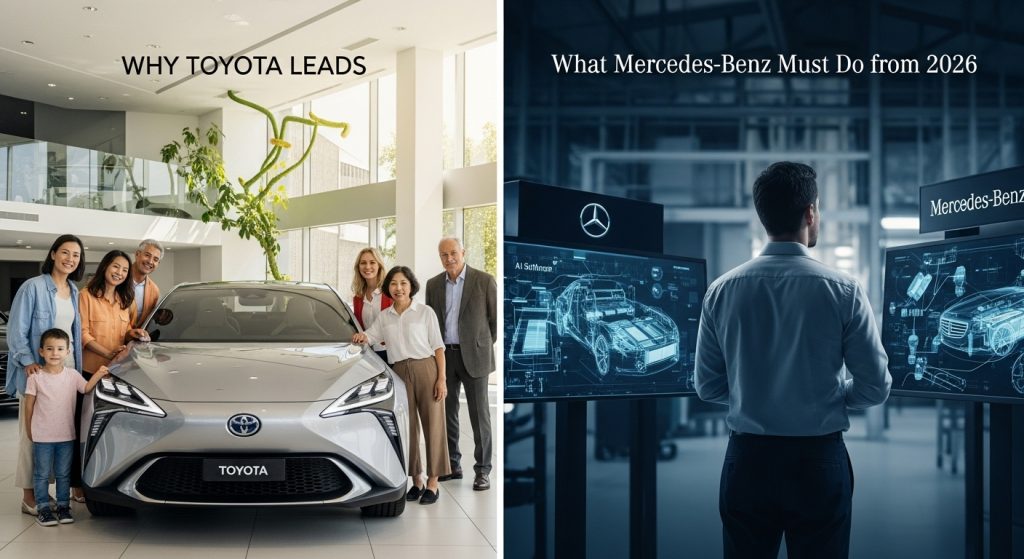
Why Toyota Leads and What Mercedes-Benz Must Do from 2026
Africa is no longer a “future market” for the automotive industry; it is an active, high-potential growth zone. The continent’s population crossed 1.5 billion people in 2024 and is projected to reach around 2.5 billion by 2050. Nigeria alone is estimated at about 237–238 million people in 2025, making it the most populous country in Africa and a top-six country globally.
Yet despite the population scale and rising demand for mobility, Africa’s motorization rate remains very low: an average of roughly 40–70 vehicles per 1,000 people, versus nearly 200 per 1,000 globally. That gap represents enormous upside — and whoever builds a fit-for-purpose strategy now will shape the market through 2030 and beyond.
In this context, Toyota has become the dominant practical brand across many African markets (including Nigeria), while Mercedes-Benz remains the aspirational luxury badge. Most middle-class Africans can own a Toyota; many of them dream of owning a Benz — but cannot justify or sustain the cost, risk and maintenance burden that comes with it.
Globally, Toyota is structurally advantaged:
- Toyota sold over 11.2 million vehicles in 2023 and around 10.8 million in 2024, retaining its position as the world’s largest automaker.
- In its fiscal year to March 2025, Toyota generated ¥48.0 trillion in net revenue and ¥4.8 trillion in operating income, maintaining very strong profitability even under tariff and currency pressure.
Mercedes-Benz, by contrast, is far smaller in volume, positioned firmly at the premium end:
ALSO, READ 2026 Website Standards: What a High-Converting Website Must Include
- The Mercedes-Benz Group generated €145.6 billion in revenue and €10.4 billion in net profit in 2024, but with operating profit down almost a third versus the previous year due to a cooling Chinese market and macro headwinds.
In Africa, these two philosophies collide: Toyota’s durability-first, cost-of-ownership-focused design versus Mercedes-Benz’s high-precision, high-luxury architecture. On Nigerian roads, that difference is not theoretical — it is felt daily in uptime, repair bills, fuel sensitivity and the availability of mechanics and parts.
This article examines:
- Why Toyota is winning Nigeria and much of Africa today
- What structural and design factors make Toyota more compatible with African realities
- Why Mercedes-Benz, despite strong brand equity, struggles to convert admiration into volume
- A concrete 2026–2030 roadmap for Mercedes-Benz to design, price and support vehicles specifically for African conditions — without destroying its premium brand equity
The goal is not Toyota-worship or Mercedes-critique; it is to provide a serious, data-informed entry strategy for premium OEMs that want to treat Africa as a core market rather than an afterthought.
1. Market Context: Nigeria and Africa in the Global Automotive Landscape
1.1 Demographics and Motorization
- Africa’s population surpassed 1.5 billion in 2024 and is on track for ~2.5 billion by 2050, potentially approaching 40% of global population by the end of the century.
- Africa is already the fastest-growing continent in population, with the world’s youngest demographic profile.
- Nigeria, with ~237–238 million people in 2025, is Africa’s largest market by headcount and a natural anchor for any continental automotive strategy.
Yet vehicle ownership remains low:
- Africa averages around 43 vehicles per 1,000 people, compared with a global average near 197 per 1,000.
- Nigeria’s older official data showed about 0.06 vehicles per person (≈60 per 1,000) as of 2018, underscoring the under-motorization and growth potential.
- Projections suggest Africa’s motorization could reach around 150 vehicles per 1,000 people by 2050, effectively more than doubling the continent’s vehicle fleet.
For global OEMs, this is not a small niche. It is the last major frontier of mass motorization.
1.2 Structure of the Nigerian Automotive Market
Nigeria’s market is overwhelmingly import-driven and heavily skewed toward used vehicles:
- The U.S. Department of Commerce estimates the Nigerian auto market at roughly 1.15 million new and used vehicles per year, with imports meeting most local demand.
- Passenger car imports alone were valued at ₦1.47 trillion in 2023, a staggering ~225% increase versus 2022, according to National Bureau of Statistics (NBS) data.
At the same time, economic realities are tough:
- Nigeria’s inflation in 2024 was estimated above 30%, with over half the population living below expanded poverty lines.
What this means in practice:
- Price sensitivity is extreme. Total cost of ownership (TCO) matters more than brand aspiration.
- Used imports dominate. Buyers gravitate to brands that remain reliable at 5, 10, or 15 years of age.
- Maintenance ecosystems drive brand choice. Availability of parts, informal mechanics and roadside repair culture are often more decisive than the logo on the grille.
In this environment, Toyota has become the default logic. Mercedes-Benz has become the default dream.
2. Global Positioning: Toyota vs Mercedes-Benz
Understanding how these brands are positioned globally helps explain how they translate into Africa.
2.1 Toyota: Scale, Robustness and Cost Discipline
Toyota’s core strengths:
- Scale & efficiency: Toyota remains the world’s top automaker by volume, with 11.2 million vehicles sold in 2023 and around 10.8 million in 2024, giving it unmatched supply chain leverage and platform scale.
- Financial resilience: In FY2025, Toyota reported ¥48.0 trillion in revenue and about ¥4.8 trillion in operating income, even as it navigated tariffs and FX volatility.
- Engineering philosophy: A reputation for robust, conservative engineering — prioritising reliability, long life cycles and low failure rates even in harsh environments.
- Global footprint: Deep penetration in emerging markets, from Southeast Asia to Latin America and Africa, with strong dealer and parts networks.
Toyota doesn’t just sell cars; it sells predictability. In under-infrastructured markets, that predictability is gold.
2.2 Mercedes-Benz: Premium, Precision and Brand Equity
Mercedes-Benz’s positioning is different by design:
- Premium focus: The group sold roughly 2.4 million vehicles globally in 2024 (cars + vans), with a strong skew toward high-margin, upmarket products.
- Profit model: In 2024 the Mercedes-Benz Group earned €145.6 billion in revenue and €10.4 billion in net profit, but with margin compression as demand softened in key markets like China.
- Technology & electronics: Modern Mercedes vehicles are rich in electronics, sensors, driver assistance systems and complex software.
- Brand meaning: In almost every culture, including African societies, Mercedes-Benz signals wealth, status, success and “arrival.”
That aspirational power is an asset — but in Africa it is not yet matched by a business model and product architecture designed for the actual operating environment.
3. Why Toyota Outperforms Mercedes-Benz in Nigeria and Much of Africa
Toyota is not winning Africa by accident. It is winning because its product-market fit aligns cleanly with African realities. Below are the main drivers.
3.1 Climate and Operating Conditions
Africa is largely a high-temperature, high-dust, high-humidity environment with significant seasonal stress (e.g., flooding in Nigeria, Sahelian dust, heat waves).
Key differences:
- Cooling systems and thermal margins: Toyota platforms used widely in Africa are known for generous cooling capacity and forgiving thermal behavior. They are engineered to operate reliably in 40–45°C conditions with poor airflow, heavy load and slow traffic.
- Material resilience: Toyota’s long experience in markets like the Middle East and sub-Saharan Africa has driven design choices in plastics, rubber seals, hoses and bushings suited for UV exposure, heat and rough use.
Modern Mercedes-Benz vehicles are also tested in hot climates, but:
- Their higher electronic density means more components that can be heat-sensitive.
- Packaging is often tighter, optimized for aerodynamics and refinement rather than easy cooling and field repair.
In practice, an over-engineered premium sedan designed for German autobahns can find itself stressed in traffic-choked Lagos at 35–40°C with marginal fuel and poor airflow.
3.2 Road Quality and Suspension Design
African roads are non-uniform:
- Urban expressways and bridges exist alongside:
- Pothole-ridden city streets
- Untarred rural roads
- Flooded corridors
- Sand, gravel and laterite surfaces
Toyota’s SUVs, pickups and even many sedans have:
- High ground clearance
- Long-travel, forgiving suspension
- Simple, rugged underbody layouts
Mercedes-Benz vehicles, especially sedans and crossovers, often have:
ALSO, READ Google Lawsuit 2025 Explained: Who Qualifies, How Much & What’s Next
- Lower ground clearance
- More sophisticated suspension (multi-link, air suspension, adaptive dampers)
- Underbody components not designed for repeated, long-term abuse from potholes and washouts
On Nigerian roads, this means:
- Toyota can be comfortably overloaded, driven through moderate flooding and used as both family and commercial transport.
- A Mercedes-Benz hitting the same environment faces higher risk of expensive suspension, wheel, tyre and underbody damage.
3.3 Fuel Quality and Engine Sensitivity
In many African markets, including Nigeria, fuel can have:
- Variable octane levels
- Higher sulphur content
- Storage contamination (water, rust, particulates)
- Adulteration along the distribution chain
Toyota engines — especially older-generation naturally aspirated petrol engines and diesel units — are known to be tolerant of imperfect fuel.
Mercedes-Benz engines, particularly recent downsized turbocharged petrol and diesel units with advanced emission controls, are far more sensitive to fuel quality:
- High-pressure injectors
- Particulate filters
- Complex emission control systems
A single episode of heavily adulterated fuel can trigger:
- Injector failure
- Pump failure
- Sensor malfunction
- Check-engine conditions
For a typical Nigerian buyer, the risk equation is simple:
Toyota = low fuel risk. Mercedes-Benz = high fuel risk.
3.4 Maintenance Ecosystem and Informal Mechanics
Perhaps the most decisive factor is not the car itself, but who can repair it.
In Nigeria:
- The majority of repairs are handled by informal or semi-formal mechanics, not OEM-certified technicians.
- Workshops rely more on experience and trial-and-error than on OBD diagnostics and factory software.
Toyota has become the default platform for this ecosystem:
- Almost every mechanic understands Corolla, Camry, Prado, Hilux and their cousins.
- Parts interchangeability across generations is common.
- Non-OEM parts are widely available and cheap.
Mercedes-Benz repairs, by contrast, often require:
- Specialized diagnostic tools
- Brand-specific software
- Deep familiarity with complex electronic systems
When owners take a modern Benz to a non-specialist mechanic, the result can be:
- Misdiagnosis
- Incorrect wiring fixes
- Bypassed modules
- Cascading failures
Over time, this raises total cost of ownership and perceived risk among buyers.
3.5 Parts Availability and Cost
Because of Toyota’s scale and long presence in Africa:
- Genuine and aftermarket parts are ubiquitous — from Lagos to smaller cities and even cross-border markets.
- Non-OEM alternatives exist at multiple price tiers.
Mercedes-Benz parts:
- Are more expensive globally, reflecting the premium nature of the brand.
- Have fewer high-quality aftermarket alternatives in African markets.
- Often require ordering, waiting and paying in foreign currency.
For fleet owners, ride-hailing drivers and middle-class households, this cost asymmetry makes Toyota the rational choice.
3.6 Resale Value and Asset Logic
Given economic volatility and high inflation, Nigerians treat cars as quasi-financial assets:
- Vehicles are expected to preserve value.
- Strong resale markets are essential.
Toyota retains exceptional resale value because:
- Demand is broad and deep.
- Mechanics know the cars.
- Parts supply is secure.
Mercedes-Benz resales can be strong for certain models, but:
- Perceived maintenance risk and cost push some buyers away from older Benz vehicles.
- Complex electronics and age-related failures can turn a once-prestige car into a liability.
From an asset-management perspective, Toyota is “capital-preserving”. Mercedes-Benz is often “status-signalling but financially fragile” for the average buyer.
3.7 Positioning vs Economic Reality
In theory, rising middle-class incomes should favor premium brands. In practice:
- Nigeria’s economy faces high inflation, FX volatility and rising poverty indicators.
- Even relatively comfortable households make highly conservative long-term purchase decisions.
The result:
- Most Toyota owners admire Mercedes-Benz and would like to own one.
- But they do the math on:
- Parts price
- Risk of electronics failure
- Fuel sensitivity
- Mechanic availability
- Impact of a single major repair on family finances
…and decide to stay with Toyota.
4. Why This Matters for Mercedes-Benz: Africa 2026–2030 as a Strategic Window
Africa’s low but rapidly rising motorization rate means that the next decade is the “lock-in period.”
If trends hold:
- Africa’s vehicle ownership could roughly double by 2050, rising from ~70 to ~150 vehicles per 1,000 people, driven by income growth and urbanization.
- Nigeria’s population and urban centers (Lagos, Abuja, Port Harcourt, Kano) will anchor a growing regional middle class.
Toyota is already deeply embedded, but premium space is still relatively open. If Mercedes-Benz treats Africa as a core strategic expansion region from 2026 onward, it can:
- Capture the aspirational upper-middle segment
- Unlock fleet and corporate demand (banks, telcos, oil & gas, large SMEs)
- Build local assembly and skills ecosystems
- Position itself as the premium brand “engineered for African roads” rather than just imported for elites
However, winning requires more than importing existing European or Chinese-built models. It demands localized engineering, pricing, assembly and service strategy.
5. A Strategic Roadmap for Mercedes-Benz in Africa (2026–2030)
Below is a concrete, CEO-level framework for how Mercedes-Benz (or any premium OEM) can structurally improve its position in Nigeria and broader Africa without diluting brand equity.
5.1 Product Strategy: “Africa Editions” That Respect the Brand
Objective: Preserve Mercedes-Benz design language and perceived quality, while re-engineering critical components for African conditions.
Key moves:
- Develop “Africa Edition” packages on existing platforms
- Higher ground clearance and underbody protection
- Simplified suspension (coil-spring + robust dampers instead of complex air systems in certain trims)
- Enhanced cooling systems for engines and transmissions
- Dust-proofing for electronics and cabin
- Offer engine variants tuned for wider fuel tolerance
- Less extreme downsizing in high-risk fuel markets
- Focus on robust, proven powertrains with fewer sensitive emissions components for selected markets (within regulatory limits)
- Calibrate electronics for “graceful degradation”
- Design systems to fail safe, keep the vehicle drivable and simplify diagnosis in low-infrastructure environments.
This is not about making Mercedes-Benz “cheap”; it is about making it operationally compatible with Nigerian realities.
5.2 Portfolio and Price Architecture: Accessible Luxury, Not Unreachable Status
Objective: Create pathways for Toyota-level customers and rising professionals to access Mercedes-Benz without being financially overexposed.
Possible levers:
- Introduce locally assembled entry-premium models
- CKD (completely knocked down) assembly in Nigeria or a regional hub to reduce duties and logistics costs.
- Focus on high-volume segments (compact SUVs, compact sedans, light vans).
- Design “TCO-aware” trims
- Smaller wheel sizes with higher-profile tyres (cheaper to replace, better for bad roads).
- Fewer optional fragile packages (e.g., avoid fragile chrome, extremely low spoilers, ultra-thin low-profile tyres in standard trims).
- Offer aggressive financing and leasing solutions
- Partner with banks, fintechs and fleet operators.
- Introduce structured maintenance-inclusive leases for SMEs, entrepreneurs and professionals.
The goal is that a Toyota Camry or RAV4 owner should see a realistic path into a Mercedes-Benz SUV or sedan without feeling that a single major repair could destabilize their finances.
5.3 After-Sales and Parts Ecosystem: From “Pain Point” to Competitive Advantage
Currently, after-sales is a weakness for Mercedes-Benz in most African markets. It can be turned into a differentiator.
- Local Parts Warehousing and Tiered Pricing
- Set up regional parts hubs (e.g., Lagos, Accra, Nairobi, Johannesburg).
- Introduce tiered parts pricing and “value line” parts for out-of-warranty vehicles.
- Training Programs for Independent Workshops
- Create Mercedes-Benz–certified training for independent mechanics and electricians.
- Offer subscription-based access to diagnostic tools and guided repair procedures.
- Transparent Service Packages
- Publish predictable, fixed-price maintenance packages for key models.
- Partner with insurers to link maintenance compliance with lower premiums.
By 2028–2030, the goal should be that owning a Mercedes-Benz in Nigeria feels logistically manageable and financially predictable, not intimidating.
5.4 Local Assembly and Industrial Partnerships
To compete with Toyota’s embedded presence, Mercedes-Benz should consider:
- Assembly Plants or Strategic JV Facilities
- CKD/SKD assembly in Nigeria or ECOWAS hub countries, leveraging AfCFTA.
- Work with local manufacturing partners or greenfield plants in collaboration with governments.
- Supplier Development and Localization
- Gradual localization of non-critical components (seats, interior trims, wiring harnesses, glass, simple stampings).
- Skills transfer programs to build an African automotive talent base.
Local assembly delivers:
- Lower landed cost
- Faster parts and model availability
- Stronger negotiation leverage with governments
- A more credible long-term presence
5.5 Brand Narrative: From “Imported Luxury” to “Engineered for African Roads”
Mercedes-Benz already owns the status narrative.
The missing narrative is reliability in African conditions.
Marketing and positioning should communicate:
- Rigorous testing of Africa Edition models on Nigerian and regional roads
- Real-world stories of durability in heat, rough terrain and heavy use
- Partnerships with African businesses, governments and entrepreneurs
In practical communication terms:
- Highlight TCO improvements and maintenance predictability, not just leather and horsepower.
- Show aspirational but realistic owners: successful entrepreneurs, tech founders, professionals — many of whom previously owned Toyota or other mainstream brands.
The message to the market becomes:
“You grew up with Toyota because it was the smart choice. Now you can step into a Mercedes-Benz that is equally smart for Nigerian roads — and still premium.”
5.6 ESG, Youth and Job Creation
Africa’s demographic and economic story is also about jobs, skills and local value creation.
A credible long-term Mercedes-Benz Africa strategy would:
- Tie local assembly and training to youth employment
- Support STEM and technical education linked to automotive technology
- Engage with governments on fair but enabling regulations (used imports, safety, emissions)
This positions Mercedes-Benz not just as a foreign brand extracting value, but as a partner in Africa’s industrial and mobility development.
6. Conclusion: Toyota Owns Today — Mercedes-Benz Can Still Shape Tomorrow
In 2023–2025, Toyota’s dominance in Nigeria and much of Africa is the logical outcome of:
- Engineering optimized for harsh climate and poor roads
- Fuel tolerance and mechanical simplicity
- Deep integration into informal mechanic networks
- Abundant and affordable spare parts
- Strong resale value and low perceived risk
Mercedes-Benz, by contrast, is admired but operationally misaligned with the constraints faced by most African owners. It is aspirational but fragile, from the perspective of the average Nigerian buyer.
However, the story is not closed.
Between 2026 and 2030:
- Africa’s population will continue to grow rapidly.
- Motorization rates will climb from extremely low baselines.
- A larger segment of Africa’s population will be able to afford entry-luxury vehicles, provided the products are engineered and priced intelligently.
If Mercedes-Benz:
- Builds Africa-specific trims and editions,
- Invests in local assembly and parts hubs,
- Trains independent mechanics,
- Offers TCO-conscious pricing and finance, and
- Repositions itself as “engineered for African roads” rather than just imported prestige,
then it can convert the deep emotional admiration it already enjoys into sustainable market share and long-term profitability in Nigeria and across the continent.
Toyota may own the present.
But for premium mobility in Africa, the future is still open.