

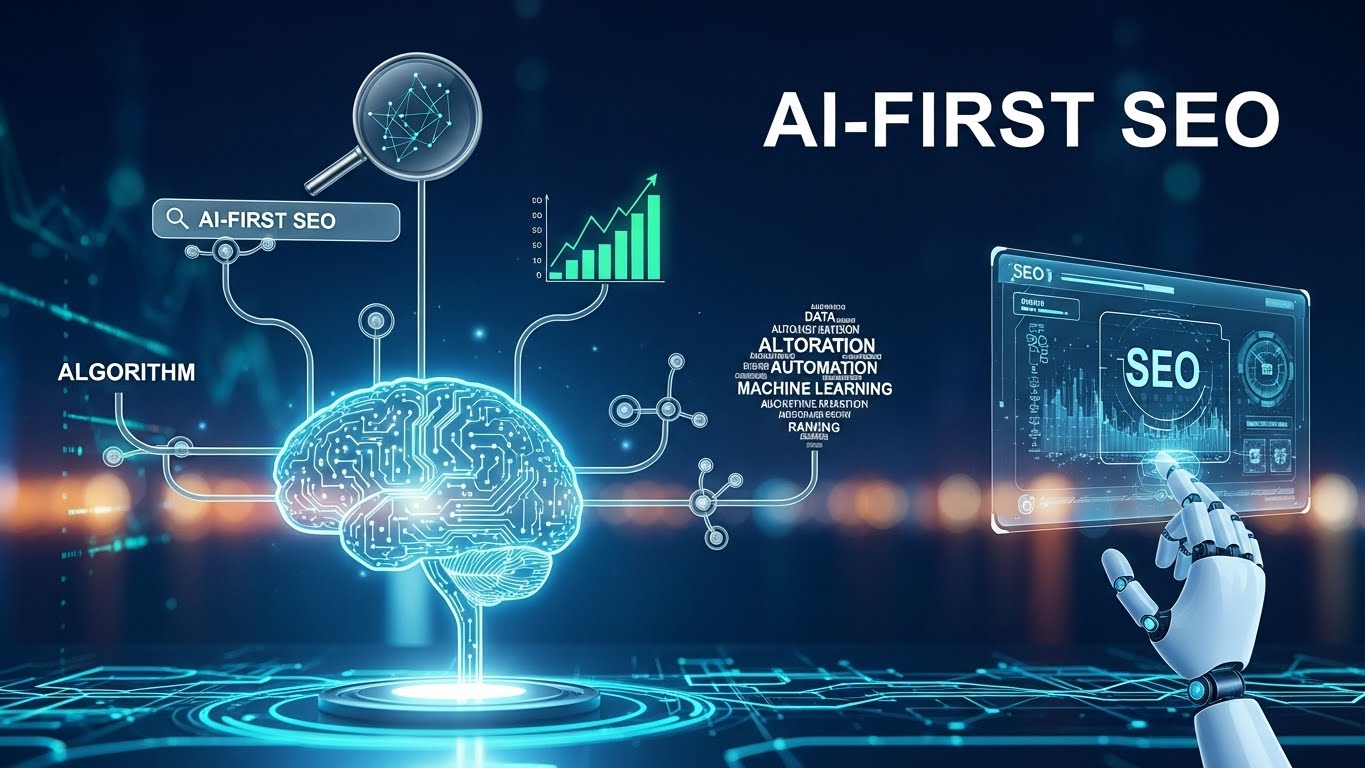
AI-First SEO in 2026: How to Rank in the New AI Search Era
For SMEs, Agencies, Founders, and Marketing Teams Preparing for the New Search Era
ITHE SEARCH LANDSCAPE HAS CHANGED FOREVER
The SEO industry has experienced more transformation in the last three years than in the previous decade combined. Traditional search engines have radically shifted their architecture. AI-powered Large Language Models (LLMs) — including ChatGPT Search, Google Gemini AI Overviews, Perplexity, Meta AI, Copilot Search, and emerging answer engines — now dominate how people discover information.
By 2026, over 60% of online search behavior has moved away from classical search engines into AI-driven “answer engines.”
This means:
- Users expect instant answers, not long pages.
- Traffic depends on answer eligibility, not rankings alone.
- Websites must optimize not only for Google but also for LLMs trained on web content.
- Traditional SEO signals like backlinks and keywords are still relevant — but not enough.
This new reality has given birth to a new discipline:
AI-FIRST SEO 2026
A framework designed specifically for businesses and websites that must remain visible in a world where AI models summarize, cite, extract, and rewrite information rather than simply list links.
This 4,000-word guide demystifies everything you need to know about ranking, visibility, and discoverability in 2026.
WHAT IS AI-FIRST SEO? (AND WHY IT MATTERS IN 2026)
AI-First SEO is the practice of optimizing content, websites, and digital assets for AI search systems, such as:
- ChatGPT Search
- Google Gemini’s AI Overviews
- Perplexity
- Meta AI Search
- Copilot Search
- Voice-first AI Assistants
- Autonomous AI Agents
- Vertical AI answer systems (Finance, Health, Travel, Business Tools)
Unlike traditional SEO, where the goal is to “rank,” AI-First SEO focuses on being referenced, cited, or used as a source by these engines.
ALSO, READ Automation vs Creativity: What Will Win the Marketing & SEO Game in 2026
This requires a different set of signals:
| AI-First Factor | Why It Matters |
|---|---|
| Semantic depth & clarity | LLMs use topic depth, not keyword density. |
| Structured data & schemas | Helps AI understand context and relationships. |
| Authority clustering | Groups of related articles rank higher in AI search. |
| Factual precision | AI models reject vague or non-verified content. |
| Brand entity recognition | AI must recognize your site as a reliable entity. |
| Answer Engine Optimization (AEO) | AI must trust your site enough to extract answers. |
| Generative Engine Optimization (GEO) | Content must be optimized for LLM generation. |
In 2026, Google is no longer the only SEO battlefield.
Visibility now depends on a multi-engine strategy.
HOW AI SEARCH WORKS (SIMPLIFIED FOR BUSINESS OWNERS)
Understanding this gives you a major advantage over competitors.
AI Search Has 3 Core Mechanisms:
1. Retrieval
AI engines first scan the web for sources with strong signals of expertise, clarity, and trust.
Sites without strong entity profiles or topic authority do not get retrieved.
2. Ranking
AI ranks sources not by keyword density but by semantic relevance, factual consistency, and content depth.
3. Generation
AI writes an answer using the highest-quality pieces of information it found.
If your site provides the clearest, most structured version of a fact — you get cited or linked.
This means:
- SEO writing must be more precise.
- Articles must have clear answers, not vague explanations.
- Websites must be technically perfect (speed, schema, UX).
- Brands must have unified topical authority around niche clusters.
AI search rewards businesses that invest in true expertise, full-topic coverage, original research, and clean site structure.
THE 7 PILLARS OF AI-FIRST SEO IN 2026

Below are the 7 non-negotiable pillars every website must implement to remain visible in AI-powered search.
PILLAR 1 — ENTITY SEO (THE FOUNDATION OF 2026 SEARCH VISIBILITY)
In AI-First SEO, your brand must be an entity — a clearly defined object in the knowledge graph of AI engines.
Why this matters:
If AI models cannot “see” your brand as an entity, they will never reference you.
How to build entity strength:
1. Consistent NAP data
Across website footer, social media, business directories, citations.
2. Strong About Page
With:
- founder profile
- mission
- certifications
- service offerings
- team structure
- HQ address
LLMs study About pages extensively.
3. Author profiles
Every article needs an author with:
- expertise
- credentials
- verifiable identity
- link to LinkedIn profile
4. Schema for entities
You need:
- Organization schema
- Person schema
- WebSite schema
- Service schema
- Author schema
- FAQ schema
Schemas are crucial because AI reads them.
5. Topical authority
You MUST own a niche cluster, such as:
- SEO
- Cybersecurity
- Web Development
- Cloud
- Digital Marketing Tools
If you publish randomly, AI cannot categorize your expertise.
PILLAR 2 — GEO (Generative Engine Optimization)
GEO is the process of making your content AI-friendly, meaning LLMs can extract meaning quickly and accurately.
ALSO, READ Google Lawsuit 2025 Explained: Who Qualifies, How Much & What’s Next
To optimize for GEO:
- Use short, clear definitions
- Use bullet points
- Add statistical clarity
- Explain concepts with precision
- Break long paragraphs
- Provide lists, steps, and formulas
- Avoid metaphor-heavy writing
- Give real examples
- Insert “AI-friendly paragraphs” (highly explicit fact-based sections)
LLMs prioritize clarity over creativity.
PILLAR 3 — AEO (Answer Engine Optimization)
This involves structuring your content to produce fast, extractable answers.
Requirements:
- H2 and H3 questions
- Short answer blocks under each question
- FAQ sections
- Summary sections at the top
- Schema-based Q&A blocks
- Glossaries of terms
The more “answer-ready” your content is, the more likely AI will cite it.
PILLAR 4 — TOPICAL AUTHORITY OF CLUSTERS
Google, ChatGPT, and Perplexity now prefer clusters, not individual posts.
A strong cluster has:
- One main pillar page
- 10–20 supporting articles
- Internal links between all cluster pages
- Schema consistency
- Consistent authorship
For example:
“SEO in 2026” →
- AI SEO
- GEO
- AEO
- Schema SEO
- Entity SEO
- E-E-A-T framework
- SEO automation tools
- SEO for local businesses
- SEO for Africa/Nigeria markets
- Future of search
Topical clustering dramatically increases retrieval rate in AI models.
PILLAR 5 — ORIGINAL RESEARCH + DATA-DRIVEN CONTENT
LLMs prioritize:
- unique data
- surveys
- statistics
- price comparisons
- expert quotes
- case studies
- test results
If your content contains original insights, AI engines must reference you.
This builds:
- links
- citations
- thought leadership
- Google Discover visibility
- AI recommendation visibility
PILLAR 6 — TECHNICAL SEO FOR AI
AI search penalizes technically weak websites more aggressively than Google ever did.
Your site must be flawless in:
- mobile performance
- Core Web Vitals (2026 update)
- zero UX friction
- structured data
- security (HTTPS, header protections)
- lightning-fast servers
- optimized images (next-gen formats)
AI needs clean, machine-readable websites.
PILLAR 7 — BRAND AUTHORITY + OFF-PAGE SIGNALS
The future of SEO is brand strength.
AI engines reference:
- brands with social proof
- brands with consistent digital identity
- brands frequently mentioned in external content
- brands with a strong publishing ecosystem
Brand is the ultimate ranking factor in 2026.
HOW TO RANK #1 IN AI SEARCH IN 2026 (STEP-BY-STEP FRAMEWORK)

Below is the exact blueprint businesses should follow.
STEP 1 — Define Your SEO Topic Authority Niche
Pick 1–3 verticals your brand will dominate.
Not 10. Not 20.
For 24SevenHUB, examples include:
- SEO + AI Search
- Web Development Standards
- Cybersecurity for SMEs
- Cloud & DevOps for African Businesses
- Digital Marketing Transformation
STEP 2 — Build Entity Strength
Implement:
- Organization schema
- About page refinement
- Author schema
- Consistent branding
- Social account alignment
- Updated logo + favicon + Google Business Profile
AI must categorize your site.
STEP 3 — Create AEO/GEO-Optimized Content
Every article must include:
- Clear definition blocks
- Extractable answers
- FAQs
- Practical steps
- Glossary
- Stats
STEP 4 — Build 2026 Topical Clusters
Create pillar pages and interlinked articles.
Example cluster:
“AI SEO 2026 Master Cluster”
- Pillar page: AI SEO in 2026
- 20 subarticles (structured around user intent)
This ensures AI engines select your domain as an authority.
STEP 5 — Optimize Technical Infrastructure for AI Search
This means:
- Sub-1.5s load time
- Perfect Core Web Vitals
- Schema hierarchy
- Cache optimization
- Cloudflare or similar protection
- Zero broken links
- Lightweight theme architecture
STEP 6 — Build Brand Authority & Citations
AI validates brands through:
- interviews
- LinkedIn articles
- guest posts
- reviews
- mentions
- press features
Invest in brand presence everywhere.
ALSO, READ 2026 Local SEO Blueprint for SMEs (Nigeria + Global Guide)
WHAT AI SEARCH REWARDS (AND WHAT IT PENALIZES)

AI Search Rewards:
- Precision
- Structure
- Expertise
- Fact-based writing
- Semantic depth
- Internal linking
- High-quality design
- Topical consistency
AI Search Penalizes:
- Keyword stuffing
- Vague writing
- Unstructured posts
- Outdated statistics
- Thin content
- Clickbait
- Slow websites
- Duplicate content
THE FUTURE OF SEO: WHAT TO EXPECT BY 2027
Predictions:
- Google reliance will drop below 40%.
- AI search will source more from niche experts than major publishers.
- Entity SEO will become the most important ranking factor.
- Websites with clean, structured information will dominate citations.
- AI Agents will perform SEO tasks automatically.
- Content without original insights will disappear from search.
Businesses prepared now will win the next decade.
CONCLUSION — 2026 BELONGS TO BRANDS WHO ADAPT EARLY
AI-First SEO is not optional.
It is not “advanced SEO.”
It is the new default.
Companies that adopt this today will dominate:
- ChatGPT Search
- Gemini
- Perplexity
- Copilot
- Meta AI
Those who ignore it will vanish from search visibility within 12–18 months.
24SevenHUB helps businesses implement:
- AI-First SEO
- Entity optimization
- GEO/AEO content
- Technical SEO
- Website performance upgrades
- Content clusters
- AI-driven automation
The future of SEO is already here.
The question is: Will your business adapt or disappear?