

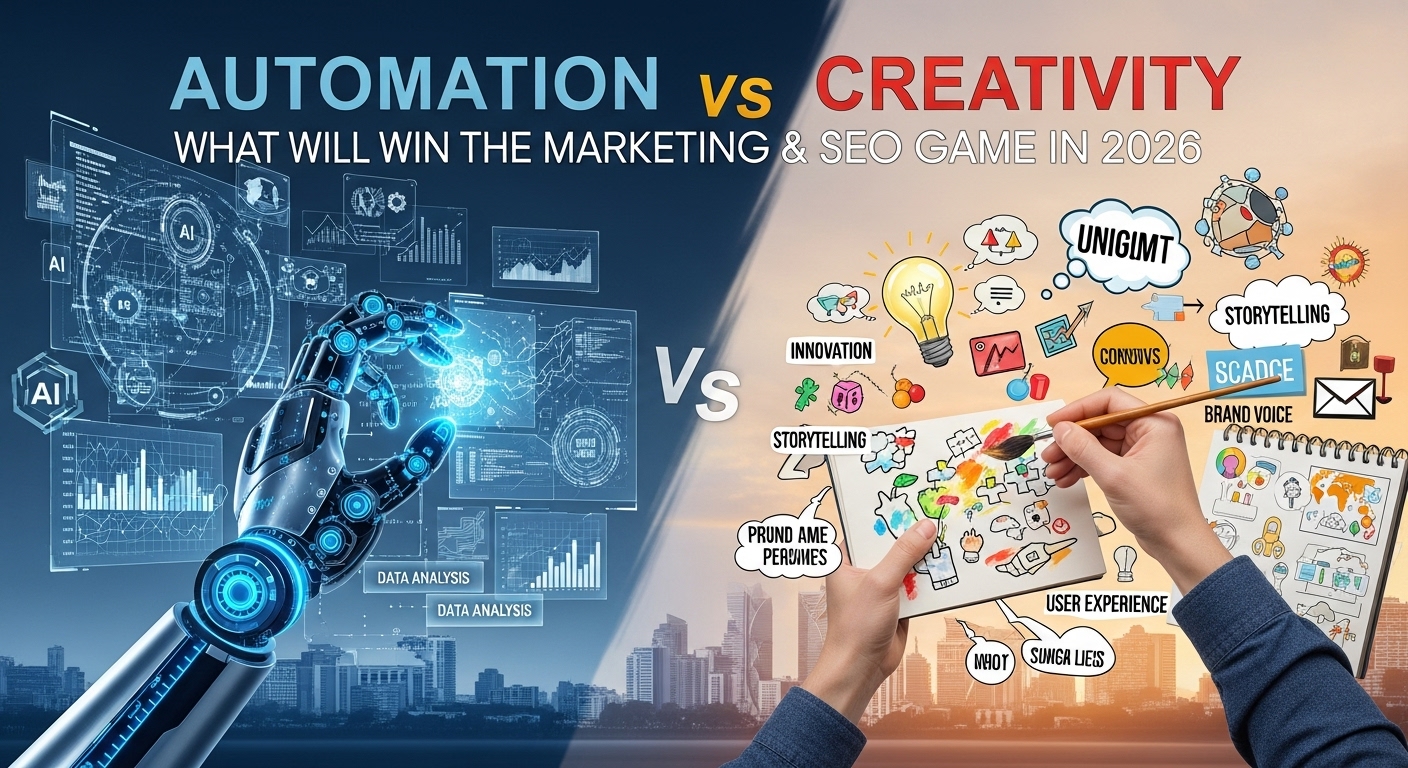
Automation vs Creativity: What Will Win the Marketing & SEO Game in 2026
Over the last decade, the marketing industry has undergone one of the most significant transformations in its history. Artificial intelligence, automation platforms, and machine-driven optimization have redefined how content is created, distributed, measured, and scaled. As we approach 2026, one strategic question has emerged across boardrooms, digital agencies, and global marketing teams:
**Will automation dominate the future of marketing and SEO—
or will creativity remain the decisive competitive advantage?**
The question is more than theoretical. It directly influences:
- how organisations structure their marketing teams
- how budgets are allocated
- how content strategies are designed
- how brands differentiate themselves
- how competitive positioning is maintained
- how search visibility is sustained in an AI-dominated environment
Automation is accelerating.
Creativity is becoming rare.
AI is flooding search engines with content.
Google’s algorithms are tightening.
Customer expectations are rising.
And the competitive landscape is shifting faster than ever.
ALSO, READ 2026 Website Standards: What a High-Converting Website Must Include
This article provides a comprehensive, professional, research-backed examination of the state of automation and creativity in marketing. It is written for:
- CEOs needing clarity before approving 2026 marketing budgets
- CMOs developing integrated digital strategies
- Growth and marketing leaders planning their talent mix
- Agencies repositioning themselves for an AI-first market
- SEO experts navigating Google’s evolving search environment
The analysis is presented through the lens of business performance, market competitiveness, and strategic innovation, aligning with the consulting-style brand of 24SevenHub.
SECTION 1 — Understanding Automation in Marketing: Definition, Capabilities & Market Direction
Marketing automation is no longer limited to email workflows or CRM triggers. The definition has expanded significantly, encompassing AI-driven content generation, predictive analytics, automated SEO optimization, autonomous media buying, personalization engines, and multi-channel orchestration.
Below is a structured view of what automation truly represents in 2026 and beyond.
1.1. Content Automation
AI-driven content automation covers:
- Article drafting
- Video scripting
- Social media scheduling and variants
- Email sequence generation
- Landing page copywriting
- Image generation
- Prompt-based video generation
- Ad variation creation
- Customer support content
- Research summarization
Leading AI platforms are trained on billions of data points, enabling them to produce first drafts in seconds. This dramatically reduces operational cost and time-to-market.
However, it introduces a widespread challenge across industries: content uniformity.
1.2. SEO Automation
SEO automation in 2026 includes:
- automated keyword clustering
- dynamic internal linking
- automated schema markup generation
- content gap identification
- programmatic page creation
- log file analysis
- backlink monitoring
- AI-driven optimization recommendations
- automated title and meta generation
- search intent categorization
This automation significantly increases output efficiency, especially for enterprise SEO programs managing tens of thousands of URLs.
1.3. Marketing Operations Automation
This includes tools that manage:
- lead scoring and qualification
- behaviour-triggered workflows
- CRM automation
- pipeline updates and alerts
- cross-channel campaign execution
- lifecycle marketing
- customer retention triggers
Automation-driven operations offer unmatched scalability and consistency, minimizing human error and maximizing touchpoint precision.
1.4. Data & Analytics Automation
AI-driven analytics include:
- predictive modelling
- customer segmentation
- churn prediction
- spend optimization
- attribution modelling
- sentiment analysis
- anomaly detection
- automated reporting
This allows executives to make faster, data-driven decisions based on statistically significant insights.
1.5. Summary: The Business Value of Automation
Automation provides:
- operational efficiency
- reduced production costs
- lower time-to-market
- improved consistency
- enhanced scalability
- increased data accuracy
- better customer targeting
However, automation alone is insufficient for competitive differentiation. It enables output—but it does not create strategic advantage.
Automation is infrastructure, not brand identity.
SECTION 2 — The Limitations of Automation: Why It Cannot Win the Market Alone
While automation offers undeniable benefits, it carries strategic weaknesses that businesses must recognize before relying on it as the core of their marketing.
ALSO, READ 2026 Local SEO Blueprint for SMEs (Nigeria + Global Guide)
2.1. Automation Produces Similarity, Not Differentiation
AI tools rely heavily on pattern recognition. They generate content based on existing structures, linguistic norms, and general market knowledge. As a result, most AI-generated content:
- sounds similar
- lacks unique perspective
- does not introduce new frameworks
- fails to demonstrate expertise
- rarely displays strategic insight
- cannot distinguish one brand from another
Differentiation is at the core of competitive advantage; automation cannot deliver it.
2.2. Google’s Policies Are Now Actively Penalizing AI-Generated Content
Between 2024 and 2025, Google deployed multiple updates targeting scaled, low-value, and AI-generated content. These updates were designed to eliminate:
- content farms
- articles written purely for SEO
- unhelpful information
- duplicate or derivative content
- programmatically generated pages
- AI content that lacks originality
Google now rewards content that demonstrates:
- expertise
- first-hand experience
- unique value
- depth of insight
- accuracy
- authenticity
These are inherently human-driven attributes.
2.3. Automation Cannot Understand Cultural Nuance, Industry Context, or Emotional Intelligence
While AI can mimic tone, it cannot:
- interpret cultural sensitivities
- understand regional markets
- apply strategic judgment
- evaluate stakeholder impact
- comprehend political or economic nuance
- apply ethical reasoning
- develop original viewpoints
- analyse non-verbal customer signals
- anticipate market sentiment shifts
Marketing relies heavily on contextual intelligence, which automation does not possess.
2.4. Automation Cannot Create Brand Identity
A brand is:
- a promise
- an emotional connection
- a voice
- a personality
- a perception
- a narrative
- a strategic position
Automation can support brand creation, but it cannot:
- assign meaning
- define values
- shape public perception
- establish emotional resonance
- create a distinct market identity
- build community loyalty
These are all outcomes of human creative leadership.
SECTION 3 — Creativity: The Irreplaceable Strategic Asset in 2026
While automation accelerates execution, creativity drives strategic advantage. In fact, the rise of AI has increased—not decreased—the importance of human creativity.
3.1. Creativity Enables Market Differentiation
Creative thinking enables brands to:
- identify gaps in the market
- craft compelling narratives
- design distinct brand voices
- create memorable experiences
- develop innovative campaigns
- shape public perception
- build thought leadership
- position themselves uniquely
Automation does not differentiate. Creativity does.
3.2. Creativity Produces Insights AI Cannot Generate
AI can analyze patterns but cannot generate new meaning. Creativity allows marketers to:
- interpret market signals
- forecast future trends
- understand customer psychology
- design strategic frameworks
- create novel concepts
- challenge industry norms
- anticipate competitive shifts
These are foundational to corporate strategy.
3.3. Creativity Enhances Customer Engagement
Customers engage more with content that is:
- thoughtful
- user-centric
- emotionally relevant
- empathetic
- original
- relatable
- insightful
- human-driven
Emotion is one of the strongest drivers of customer loyalty. Automation cannot generate genuine emotion.
3.4. Creativity Drives Human-Led Brand Authority (E-E-A-T)
Google prioritizes content that demonstrates:
- Expertise
- Experience
- Authority
- Trustworthiness
Creativity enables brands to produce content that establishes:
- leadership
- credibility
- industry recognition
- customer trust
- authoritative insights
AI cannot replicate lived experience. Creativity builds authority that is future-proof.
SECTION 4 — The Future Is Neither Automation Nor Creativity Alone: It Is the Intelligent Integration of Both
The misconception in the industry is that automation and creativity are in competition. They are not.
The highest-performing marketing organizations in 2026 will integrate both disciplines into a unified strategic model.
4.1. The Augmented Marketing Framework
This framework recognizes:
- Automation as force multiplier
- Creativity as strategic differentiator
The combination generates exponential competitive advantage.
4.2. Stage 1: Strategy (Creativity-Led, AI-Assisted)
Critical tasks requiring human creativity:
- defining market positioning
- customer segmentation
- value proposition development
- brand architecture
- messaging hierarchy
- campaign concepts
- performance KPIs
AI assists with:
- data collection
- competitor analysis
- keyword clustering
- market research summarization
4.3. Stage 2: Creation (Creativity-Led, Automation-Supported)
Humans lead:
- messaging
- brand tone
- content direction
- editorial quality
- storytelling
- industry-specific insights
Automation supports:
- drafting
- repurposing
- variation testing
- optimization
- technical compliance
- visual content prompts
4.4. Stage 3: Distribution (Automation-Led, Creatively Directed)
Automation handles:
- scheduling
- email workflows
- audience segmentation
- personalization
- retargeting
- A/B testing
- cross-channel coordination
Creativity determines:
- channel selection
- messaging alignment
- asset design
- audience relevance
- campaign positioning
4.5. Stage 4: Optimization (Automation-Led, Human Interpreted)
AI handles:
- performance tracking
- trend identification
- anomaly alerts
- optimization suggestions
Humans make:
- strategic interpretations
- resource allocation decisions
- campaign pivots
- performance assessments
- creative adjustments
SECTION 5 — How 24SevenHub Helps Businesses Combine Automation & Creativity to Win

As a digital consulting and growth partner, 24SevenHub specialises in implementing hybrid marketing ecosystems that unify automation and creativity.
ALSO, READ Integrated Marketing for SMEs: SEO, Security & Cloud Guide
Our methodology includes:
5.1. AI-Enhanced SEO Strategy
We combine:
- technical accuracy (automation)
- editorial expertise (creativity)
- compliance with search algorithms
- thought leadership content
- brand differentiation
- conversion-focused architecture
This ensures visibility in AI-powered search environments.
5.2. Automation Systems That Enhance, Not Replace Human Insight
Our automation stack strengthens:
- lead nurturing
- CRM workflows
- pipeline visibility
- cross-channel marketing
- reporting accuracy
- personalization at scale
Automation eliminates bottlenecks; creativity drives message impact.
5.3. Original Content Frameworks, Not Generic AI Output
We develop:
- original research
- case studies
- industry-specific insights
- strategic content hubs
- defensible content assets
- long-form authoritative resources
This approach builds trust, longevity, and competitive defensibility.
CONCLUSION — What Will Win in 2026 and Beyond?
The answer is clear:
**The future does not belong to automation.
The future does not belong to creativity.
The future belongs to organisations that integrate both intelligently.**
Automation delivers efficiency.
Creativity delivers differentiation.
Together, they deliver market dominance.
Companies that rely solely on automation will become generic.
Companies that rely solely on creativity will become slow.
Companies that merge both will lead their industries.
This is the strategic direction forward—for CEOs, CMOs, and enterprise decision-makers preparing for 2026 and beyond.