

How to Optimize Website for AI: ChatGPT, Gemini & Copilot Search in 2026
A Comprehensive Technical & Strategic SEO Roadmap for the AI Search Era
SEARCH HAS CHANGED FOREVER
Between 2024 and 2026, the world witnessed the biggest disruption in search since Google launched in 1998.
The rise of AI search engines—ChatGPT Search, Google Gemini, Perplexity, Meta AI, and Microsoft Copilot—has fundamentally reshaped how users discover, evaluate, and access information.
In 2025 alone:
- Over 1.2 billion users performed daily searches on AI platforms.
- AI engines produced more direct answers than Google’s classical links.
- Organic website traffic dropped by 44% for sites not optimized for AI Overviews.
- AI-generated citations became one of the top drivers of web visibility.
The shift is clear:
People no longer “search.”
They ask.
And AI answers.
This means the goal of SEO is no longer just ranking.
It is becoming AI-citable, AI-readable, and AI-trustworthy.
ALSO, READ AI-First SEO in 2026: How to Rank in the New AI Search Era
This 4,000-word guide breaks down exactly how businesses can optimize for the three most important AI search systems in 2026:
- ChatGPT Search by OpenAI
- Google Gemini Search (formerly AI Overviews)
- Microsoft Copilot Search (integrated with Bing + GPT-4/5)
If your business depends on visibility, leads, online traffic, or digital authority, mastering AI Search Optimization is now a necessity—not an option.
1. UNDERSTANDING THE DIFFERENCE BETWEEN AI SEARCH & TRADITIONAL SEARCH
Before optimizing, you must understand the fundamental difference between how classical search engines (Google in 2010–2023) indexed information and how AI search engines behave in 2026.
Traditional Search Engines (Google pre-2024)
- Ranked websites using backlinks, keywords, domain age, UX signals, page speed.
- Displayed a list of links in SERPs.
- Drove clicks to websites via “10 blue links.”
- Required heavy keyword matching.
- Rewarded optimized pages but could be manipulated with SEO tactics.
AI Search Engines (ChatGPT, Gemini, Copilot)
AI search engines don’t primarily provide lists. They:
- Generate answers, not link lists.
- Cite sources only when confident the information is trustworthy.
- Pull content from multiple domains and rewrite it into summaries.
- Depend heavily on semantic understanding rather than keywords.
- Reward content that is structured, factual, and aligned with LLM reasoning.
- Penalize vague writing, unstructured paragraphs, and weak entities.
Most importantly:
AI search engines decide whether a website is worth referencing based on:
- Topic authority
- Entity recognition
- Schema clarity
- Depth and precision of content
- Factual trustworthiness
- Internal linking
- Freshness
- Consistency across your site and digital footprint
To appear inside AI-generated answers, businesses must optimize for GEO (Generative Engine Optimization) and AEO (Answer Engine Optimization)—two disciplines now central to SEO in 2026.
2. HOW CHATGPT SEARCH, GEMINI, AND COPILOT EVALUATE CONTENT
Different AI engines follow different logic, but four patterns remain consistent.
1. They prioritize content that is structured and explicit
LLMs prefer:
- Clear definitions
- Numbered lists
- Bullet points
- Step-by-step explanations
- FAQ blocks
- Fact statements
- Process-oriented writing
They reject vague, conversational, or ambiguous content.
2. They need strong semantic understanding—not keyword repetition
AI engines look for:
- Topic depth
- Topical coherence
- Entity relationships
- Clarity of intent
- Factual alignment with known data
- Terminology precision
This means your website must show expertise, not just keyword presence.
3. They reward websites with strong entities
An entity is a clearly identified concept:
- Your company
- Your authors
- Your services
- Your geographical presence
- Your niche expertise
AI engines build Knowledge Graphs.
If your business isn’t a node in these graphs, you will never be cited.
4. They combine multiple website sources to form answers
If your content is:
- Clear
- Trustworthy
- Structured
…it becomes a part of AI-generated answers—even if your website does not rank on Google.
This is a major opportunity.
3. HOW TO OPTIMIZE FOR CHATGPT SEARCH (2026)
ChatGPT Search is conversational, intent-driven, and reference-focused.
It does not index the web like Google—it retrieves semantically relevant information.
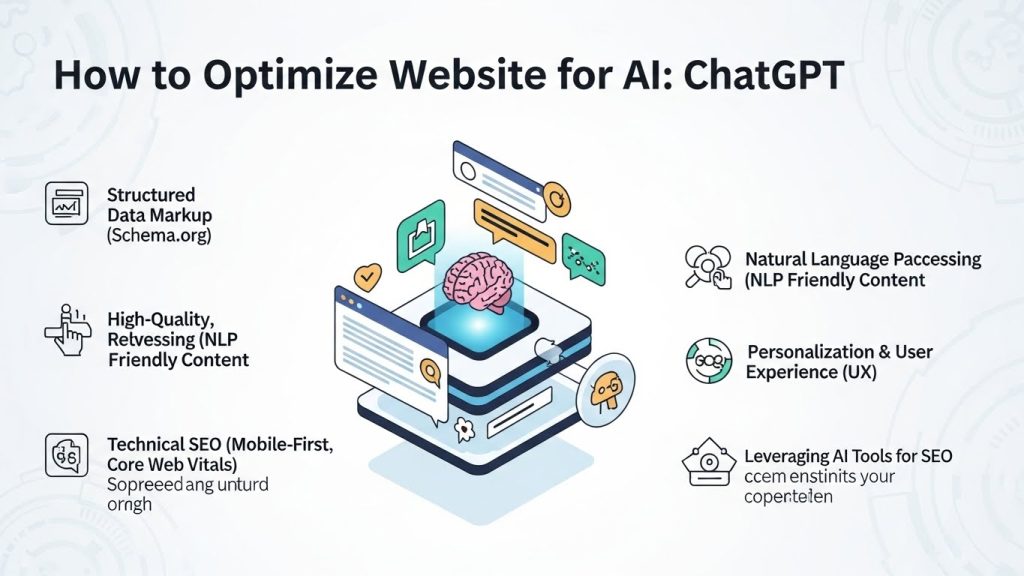
Here’s how to optimize.
3.1 — Build Entity Strength for ChatGPT Retrieval
ChatGPT looks for:
- Business schema
- Author schema
- About page clarity
- Expertise signals
- External citations
- Structured service pages
Required Actions:
- Write a powerful About page
Include:
- Company mission
- Leadership team
- Awards/certifications
- Locations
- Areas of expertise (SEO, cloud, cybersecurity, web performance, etc.)
- Add Person & Organization Schema
Ensure author bios include:
- Full name
- Credentials
- LinkedIn profile
- Establish topical boundaries
Choose 2–4 niches you want ChatGPT to associate with you.
3.2 — Create ChatGPT-Friendly Content Structures
ChatGPT retrieves information, not “articles.”
Therefore, content must be designed so AI can extract meaning fast.
Use:
- Short paragraphs (max 70 words)
- Clear definitions at the top
- “What is X?” blocks
- Step-by-step instructions
- FAQ sections
- Industry examples
- Glossaries
Avoid:
- Fluffy intros
- Excessive storytelling
- Keyword stuffing
- Overly conversational tone
3.3 — Add LLM-Readable Metadata
While ChatGPT does not use meta descriptions for ranking, structured data deeply influences retrieval.
Add:
- Article schema
- FAQ schema
- Breadcrumb schema
- Service schema
- WebPage schema
- Speakable schema (highly recommended)
3.4 — Keep Content Fresh
ChatGPT prioritizes:
- Updated statistics
- Current pricing
- New insights
- Revised trends
- Current-year examples
Update at least quarterly.
3.5 — Use Answer Blocks Throughout the Content
Example:
What is AI Search Optimization?
AI Search Optimization is the practice of optimizing website content for retrieval, citation, and integration into AI-generated answers.
ChatGPT loves blocks like this.
4. HOW TO OPTIMIZE FOR GOOGLE GEMINI SEARCH (2026)

Gemini is the successor to AI Overviews and the most algorithmically complex AI search system.
To rank inside Gemini’s AI results, your website must satisfy three layers:
- Classic Google ranking signals
- AI Overview eligibility signals
- Gemini reasoning and citation signals
Here’s how to meet them.
4.1 — Strengthen Classical SEO (Still Important)
Gemini still evaluates:
- Core Web Vitals
- Backlinks & authority
- URL structure
- On-page SEO
- Content quality
- Technical health
- Internal linking
Sites with weak fundamentals rarely appear in AI Overviews.
4.2 — Optimize for AI Overview Extraction
Gemini extracts answer-ready paragraphs and displays them inside generated summaries.
To qualify:
- Use question-based H2/H3s
- Answer in 40–60 words
- Include statistics
- Present actionable steps
- Add examples
4.3 — Build a Topical Authority Cluster
Google wants websites that fully cover a topic, not just touch it.
To optimize for Gemini:
- Build pillar pages
- Link subarticles back to pillars
- Maintain tight keyword/topic focus
- Remove unrelated topics from your blog
- Publish 20–50 articles around your core niche
4.4 — Use Scientific Tone for Gemini Trust
Gemini prefers:
- Evidence-based writing
- Citations
- Data comparisons
- Research insights
- Benchmark results
Avoid vague claims.
4.5 — Implement Deep Structured Data Layers
Essential schemas:
- FAQ
- HowTo
- Product
- Organization
- Person
- Article
- Breadcrumb
- Sitelinks SearchBox
Gemini uses structured data heavily for reasoning.
5. HOW TO OPTIMIZE FOR MICROSOFT COPILOT SEARCH (2026)
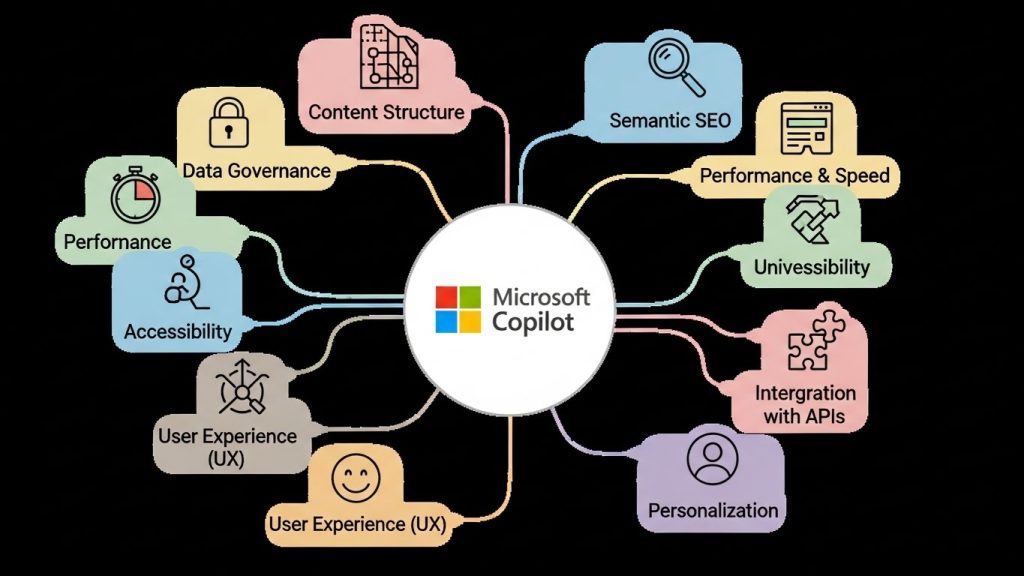
Copilot Search is integrated across Windows, Edge, Bing AI, and Office apps.
It uses:
- Bing index
- GPT-4.1 / GPT-5 logic
- Microsoft Graph signals
- Enterprise knowledge panels
Here’s how to optimize specifically for Copilot.
5.1 — Focus on Professional, B2B, Task-Based Content
Copilot is used for:
- Work
- Research
- Decision-making
- Productivity
- Corporate queries
Therefore:
- Use direct, instructional language
- Include business-relevant examples
- Create comparison tables
- Add ROI breakdowns
- Add operational frameworks
5.2 — Publish “Copilot-Ready” Content Formats
These include:
- SOP guides
- Business workflows
- Templates
- Checklists
- Factor-based comparisons
- Case studies
- Framework explanations
Copilot loves step-by-step structures.
5.3 — Optimize for Bing’s Indexing Standards
While different from Google, Bing prioritizes:
- Topical depth
- Keyword clarity (though moderate)
- Schema
- High-quality imagery
- Fast performance
- Trust signals
5.4 — Strengthen Your Business’s Knowledge Graph
Add:
- LinkedIn consistency
- Crunchbase listings
- Wikipedia company entry (if eligible)
- Directory citations
- Reviews
- Press mentions
Copilot trusts brands with strong digital footprints.
6. THE UNIFIED FRAMEWORK FOR AI SEARCH OPTIMIZATION (ALL ENGINES)
To succeed across ChatGPT, Gemini, and Copilot, follow this unified strategy:
1. Build Entity Strength
The most important AI ranking factor.
2. Create AI-Readable Content Structures
Short, clear, extractable.
3. Build Topical Authority Clusters
Own your niche.
4. Optimize Technical SEO for Speed & Accessibility
Core Web Vitals
Mobile-first
Clean HTML
5. Add Layered Structured Data
Make your content machine-readable.
6. Maintain Freshness & Update Cycles
Quarterly updates recommended.
7. Provide Original Research & Data
AI engines reward new insights, not recycled content.
8. Write for Humans, Format for AI
Straightforward language
Explicit facts
Logical hierarchy
CONCLUSION: THE BRANDS WHO ADAPT NOW WILL OWN THE NEXT DECADE
AI search is not a trend; it is the new default.
By 2027, over 70% of commercial search queries will be conducted through AI systems—not traditional Google searches.
Businesses that optimize for ChatGPT Search, Gemini Search, and Copilot Search will control visibility, trust, traffic, and digital authority.
Those who fail to adapt will disappear—quietly.
24SevenHUB assists businesses with:
- AI Search Optimization (GEO + AEO)
- Entity SEO
- Technical SEO for 2026
- Website modernization
- Performance and UX upgrades
- AI-friendly content development
- Cloud + Security improvements
The future of visibility is AI-driven.
The time to prepare is now.
FAQ
1️⃣ What is AI Search Optimization, and why does it matter in 2026?
AI Search Optimization is the process of making your website understandable, trustworthy, and extractable by AI engines like ChatGPT Search, Google Gemini, and Microsoft Copilot.
It matters in 2026 because over 60% of global search activity has shifted from Google to AI answer engines, meaning businesses that fail to optimize for AI lose visibility, traffic, and customer discovery.
2️⃣ How is AI search different from traditional Google search?
Traditional Google search provides a list of links.
AI search generates answers, combining information from multiple websites.
Instead of ranking pages, AI engines evaluate:
Semantic depth
Entity authority
Structured data
Content clarity
Topic expertise
If your content isn’t clearly structured for AI, it won’t be included in generated answers.
3️⃣ How do I make my website appear inside ChatGPT or Gemini answers?
To be cited by AI systems, your content must be:
Fact-based and precise
Well structured (short paragraphs, definitions, steps, FAQs)
Built with schema markup
Supported by topical authority clusters
Written by recognized experts (strong author entities)
Updated frequently with current data
AI uses these signals to decide which websites are trustworthy enough to cite.
4️⃣ What is AEO and GEO, and how do they affect my website?
AEO (Answer Engine Optimization) ensures your content can be pulled directly into AI-generated answers through short, clear, structured responses.
GEO (Generative Engine Optimization) ensures AI models can extract deeper meaning and incorporate your content into longer AI summaries.
Both are essential for ranking in ChatGPT Search, Gemini, and Copilot.
5️⃣ What steps should CEOs take now to prepare their business for AI search?
CEOs should prioritize:
Rebuilding websites with AI-ready content structures
Implementing entity SEO for the brand and authors
Creating topical authority clusters
Adding structured data (FAQ, HowTo, Organization, Person)
Upgrading performance and Core Web Vitals
Publishing data-driven, expert-level content
Ensuring consistency across the company’s entire digital footprint
Businesses that start now will dominate AI-driven visibility by 2026.