

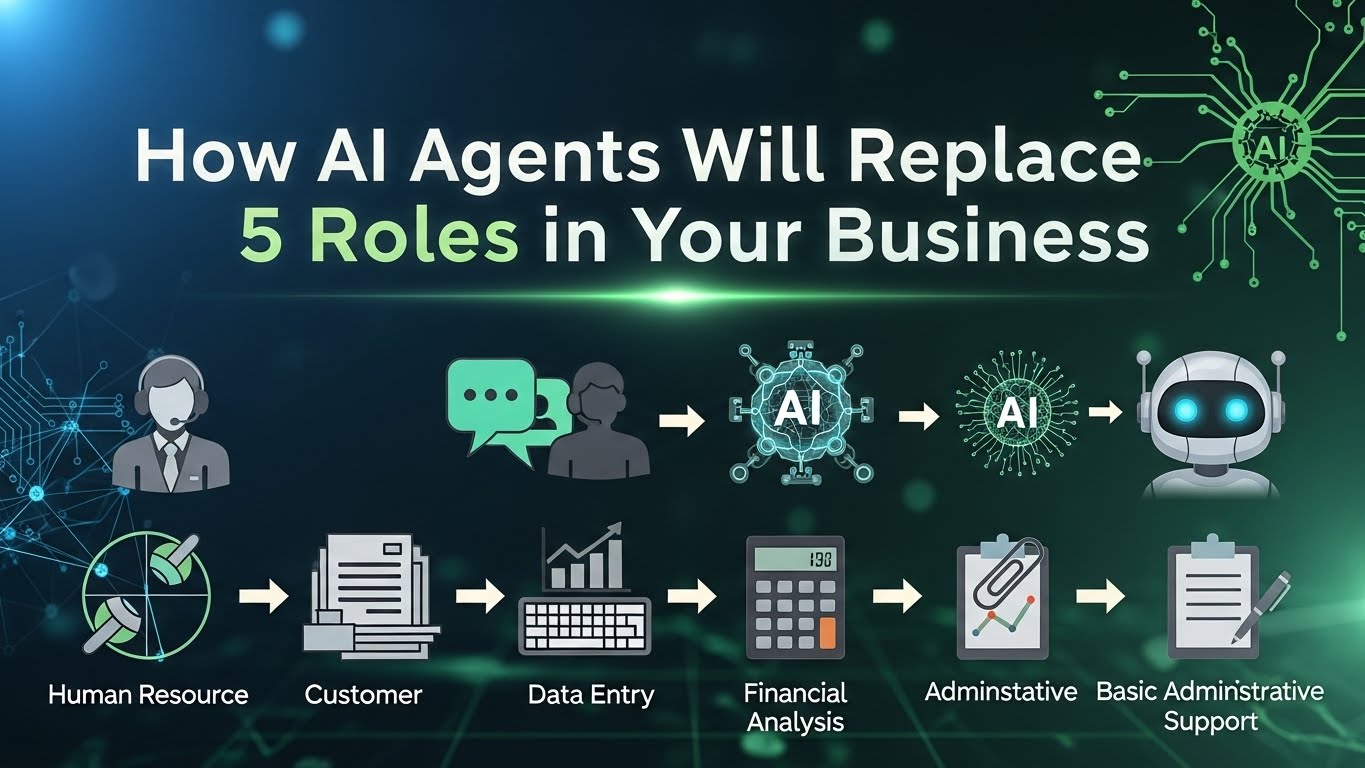
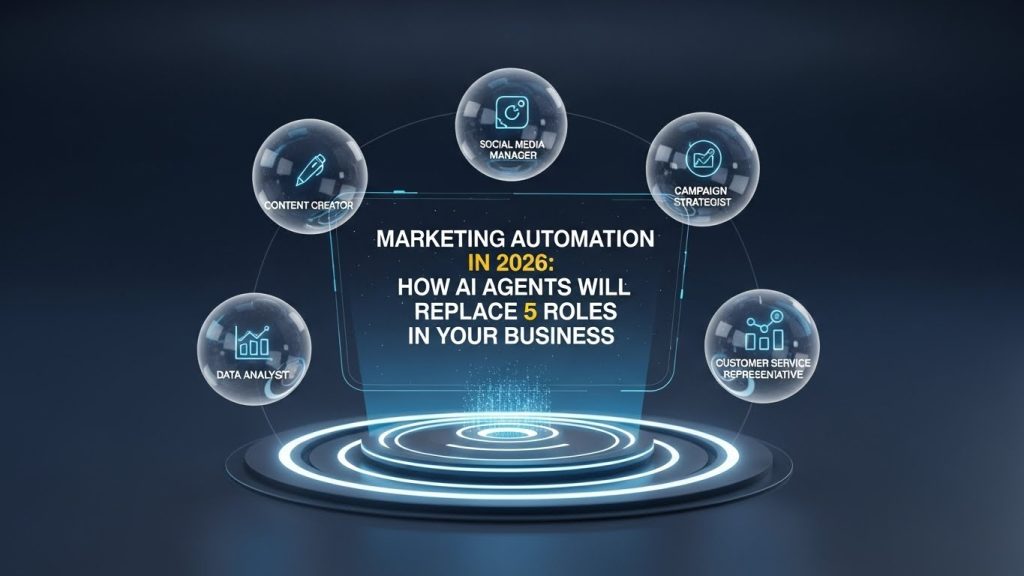
Marketing Automation in 2026: How AI Agents Will Replace 5 Roles in Your Business
INTRODUCTION: The Year Marketing Finally Outgrows Human Speed
Every decade in business leaves behind a set of roles, tools, and methods that once felt indispensable.
In 2026, the next wave of obsolescence will not come from new platforms or market trends… but from a new kind of worker:
AI Agents — autonomous, decision-making digital employees capable of performing multi-step tasks without supervision.
Not software.
Not bots.
Not automations in the traditional sense.
But agents — operational units that behave like miniature departments.
And their arrival marks a decisive turning point in marketing.
For the first time in history, marketing no longer scales with the size of your team.
It scales with the intelligence of your systems.
Tight budgets don’t limit output.
Small teams don’t limit capability.
Execution is no longer constrained by “how much you can manage.”
ALSO, READ How to Optimize Website for AI: ChatGPT, Gemini & Copilot Search in 2026
Once you deploy AI agents inside your marketing stack, your business begins to operate in a world where:
- campaigns launch themselves
- research runs on autopilot
- customer conversations happen 24/7
- analytics analyze you
- personalization happens in real time
- decision-making becomes faster than competitors can react
In 2026, the companies that win will be the ones that treat marketing like a programmable, self-optimizing growth organism.
And that transformation begins by understanding the five roles AI agents will replace — not hypothetically, but aggressively, predictably, and permanently.
This is not a warning.
It’s an opportunity.
Because every role an AI agent takes over doesn’t eliminate value — it frees humans to create new value.
Let’s explore what this future looks like, why it’s happening so fast, and how forward-thinking founders and CEOs can position themselves on the winning side of the shift.
Why 2026 Is the Breaking Point for Human-Only Marketing Teams
Marketing has always evolved, but until now, evolution required human adoption:
- CRM tools didn’t replace sales reps.
- Social media didn’t replace marketers.
- Analytics didn’t replace strategists.
- Automation didn’t replace managers.
But in 2026, the curve finally bends.
AI systems can now:
- reason
- plan
- coordinate
- execute
- evaluate
- optimize
- and loop the process continuously
This is the first time marketing has a self-running layer.
Not because humans are inadequate — but because the volume, speed, and complexity of modern marketing have crossed a threshold where:
No human team, regardless of size, can:
- process millions of data points per minute
- run endless A/B tests in parallel
- monitor every customer touchpoint simultaneously
- produce personalized content for 50 audience segments
- respond instantly across 9 communication channels
Humans cannot work at machine resolution.
AI agents cannot think with human creativity.
But marketing in 2026 will not choose between them.
It will combine them.
AI handles operations.
Humans handle direction.
This new division of labor sets the stage for understanding the five marketing roles that will be overtaken by AI agents — and why.
The Rise of AI Agents: What They Actually Are (Not the Buzzword Version)
AI agents are often misunderstood as:
❌ chatbots
❌ automation scripts
❌ workflow templates
❌ smart assistants
None of these definitions come close.
A true AI agent is:
A digital worker with autonomy, memory, decision-making ability, and multi-step execution capacity.
It can:
- receive a goal
- break the goal into tasks
- execute each task
- learn from results
- correct itself
- repeat without supervision
Imagine an employee who never sleeps, never loses focus, never forgets instructions — and can run thousands of marketing experiments simultaneously.
Not a tool.
A workforce multiplier.
And companies that deploy agents early will operate at a speed the human-only competitors cannot match.
The next sections examine the specific marketing roles that AI agents are already replacing — and will fully dominate by 2026.
The 5 Marketing Roles AI Agents Will Replace in 2026
Below are the roles, not from theory, but from what is already happening inside high-performance marketing teams worldwide.
Each includes:
- What humans do today
- How agents outperform them
- How this changes business operations
- What happens to the human talent in the process
This is the closest thing to a blueprint for the future.
ROLE 1 — The Marketing Researcher & Data Analyst
WHAT THE HUMAN ROLE LOOKS LIKE TODAY
A modern marketing researcher does more than Google searches.
They analyze:
- competitors
- audiences
- trends
- keywords
- customer behavior
- content performance
- buyer psychology
- industry movement
They summarize insights, produce reports, and transmit these insights to decision-makers.
It’s essential work — but painfully slow.
WHY AI AGENTS TAKE OVER
AI agents can collect, compare, interpret, and synthesize data at a depth no human team can match.
A single research agent can:
- scan 200 competitor websites in 90 seconds
- analyze 6 months of search trends instantly
- map buyer journeys from thousands of sessions
- identify hidden patterns in user behavior
- forecast audience interest shifts
- cluster keywords into high-opportunity groups
- create complete research briefs for campaigns
And while humans need context-switching breaks, AI agents simply loop:
Research → Insight → Recommendation → Update
THE NEW REALITY FOR BUSINESS
Research becomes:
- continuous
- real-time
- predictive
Instead of teams waiting for quarterly reports, CEOs will make decisions based on live intelligence streams.
Humans don’t disappear.
They simply move into:
- insight curation
- strategic interpretation
- decision-making
- product direction
AI does the heavy lifting.
Humans apply wisdom.
ROLE 2 — The Social Media Manager
WHAT THE HUMAN ROLE LOOKS LIKE TODAY
A social media manager must:
- plan content
- write captions
- schedule posts
- research trends
- reply to comments
- monitor sentiment
- adjust strategy
- track analytics
Even for a small brand, this is overwhelming.
WHY AI AGENTS TAKE OVER
In 2026, social media becomes an AI-first environment.
Agent capabilities include:
- predictive content scheduling
- adaptive posting based on platform behavior
- automated comment moderation
- instant DM responses
- sentiment scoring
- auto-generated content variations
- cross-platform distribution
- community filtering and analysis
An AI social agent does not simply post.
It orchestrates.
ALSO, READ AI-First SEO in 2026: How to Rank in the New AI Search Era
It manages a living ecosystem of conversations, reacts instantly, and adjusts the social strategy dynamically.
THE NEW REALITY FOR BUSINESS
Social media becomes:
- more conversational
- more personalized
- more dynamic
- more responsive
Humans shift to:
- brand voice control
- creative direction
- community leadership
- cross-channel unification
The repetitive workload disappears.
The strategic value increases.
ROLE 3 — The Content Creator & Copywriter (Baseline, Non-Expert Work)
WHAT THE HUMAN ROLE LOOKS LIKE TODAY
Writers spend enormous time producing:
- blogs
- ads
- email sequences
- landing pages
- product descriptions
- newsletters
- scripts
Most of this work is format-driven, not creativity-driven.
WHY AI AGENTS TAKE OVER
AI agents now generate:
- audience-specific content
- SEO-aligned writing
- multi-variant ad copy
- tone-controlled messaging
- narrative-structured blogs
- conversion-tested landing pages
But the true revolution is adaptive content optimization:
Agents can:
- rewrite based on real-time performance
- test multiple versions
- adjust tone for segments
- produce unlimited variations
This is beyond human capacity.
THE NEW REALITY FOR BUSINESS
Human writers are not eliminated.
Instead, they become:
- editorial directors
- storytellers
- brand stewards
- creative overseers
AI handles:
- volume
- speed
- optimization
Humans handle meaning and originality.
ROLE 4: The Customer Support & Live Chat Agent (Marketing Support Layer)
WHAT THE HUMAN ROLE LOOKS LIKE TODAY
Support and marketing are now intertwined.
Customers expect:
- instant answers
- personalized guidance
- product recommendations
- onboarding help
- troubleshooting
And they want it 24/7.
WHY AI AGENTS TAKE OVER
With autonomous reasoning, customer-facing agents can:
- resolve queries
- recommend products
- detect intent
- guide buyers
- escalate issues
- track sentiment
- maintain memory across interactions
This is not yesterday’s chatbot.
This is a functional digital employee.
THE NEW REALITY FOR BUSINESS
- Conversion rates increase
- Support costs drop
- Response times shrink
- Customer satisfaction rises
AI becomes the first line of interaction.
Humans become specialists who intervene only when the case requires nuance.
ROLE 5: The Marketing Operations Manager (Automation + Coordination)
WHAT THE HUMAN ROLE LOOKS LIKE TODAY
This role coordinates:
- workflows
- campaigns
- analytics
- tool integration
- team alignment
- scheduling
- reporting
It is mentally exhausting and permanently behind schedule.
WHY AI AGENTS TAKE OVER
AI operations agents can:
- build automated workflows
- monitor funnel leakage
- reallocate budget
- coordinate campaigns
- send reminders
- verify execution
- generate reports
- detect anomalies
- optimize costs across tools
They become the operational backbone of a digital marketing ecosystem.
THE NEW REALITY FOR BUSINESS
Marketing operations becomes:
- self-regulating
- self-correcting
- deeply automated
Humans shift from “managing processes” to designing systems.
ALSO, READ Cloudflare Outage Nov 2025: Multi-CDN Strategy for Digital Resilience
What Businesses Gain When AI Agents Replace These Roles
1. Unmatched Speed
Agents execute in seconds what teams execute in days.
2. Higher Accuracy
No fatigue, no oversight errors, no shifting attention.
3. Cost Compression
One agent replaces 3–7 traditional roles.
4. 24/7 Execution
Work continues while the business sleeps.
5. Infinite Scalability
Agents don’t get overwhelmed by volume.
6. Frictionless Experimentation
Continuous A/B tests, micro-tests, and adaptive optimization.
7. Strategic Liberation
Teams shift to:
- creativity
- innovation
- product quality
- leadership
- customer understanding
What Humans Still Do Better (And Will Continue To Own in 2026)
AI is powerful, but even in 2026 it cannot replace:
- intuition
- leadership
- ethics
- judgment
- complex creativity
- cultural nuance
- emotional intelligence
Marketing remains a human-directed discipline, even when executed by machines.
The companies that thrive will be the ones who intentionally:
- automate the repetitive
- elevate the strategic
- merge human creativity with machine acceleration
This hybrid model is the future.
A Framework CEOs Can Use to Adopt AI Agents in 2026
Here is a simple blueprint used by high-performing organizations:
STEP 1 — Audit Your Marketing Workflows
Identify tasks that are:
- repetitive
- predictable
- rules-based
- data-driven
- communication-heavy
These are agent-ready.
STEP 2 — Assign the First Agent to One Role
Do not automate everything on day one.
Start with:
- Research Agent
OR - Social Agent
OR - Customer Support Agent
This creates a measurable “before and after.”
STEP 3 — Build the Multi-Agent Stack
Once one agent works, add:
- Content Agent
- Automation Agent
- Analytics Agent
These agents collaborate to run entire marketing campaigns independently.
STEP 4 — Move Human Talent Upward
Your team becomes:
- strategists
- reviewers
- creative thinkers
- system architects
Agents handle execution.
Humans handle direction.
STEP 5 — Let AI Own the Repetition, Let Humans Own the Growth
This is the final equilibrium —
the version of your company ready for 2026 and beyond.
Real-World Example: How a 3-Person Business Outperformed a 20-Person Competitor Using AI Agents
A boutique eCommerce brand adopted three marketing agents:
- A research agent
- A content agent
- A customer support agent
Within 90 days:
- Content volume increased 400%
- Customer support response time dropped from 6 hours to 3 seconds
- Ad CTR increased by 37%
- Email automation generated 28% more revenue
- They overtook a competitor with a huge marketing team
Not because they had more people —
but because they had faster processes.
This is the new competitive advantage.
By 2026, AI Agents Won’t Be Optional — They Will Be Operational
Today, adopting AI agents gives a business an advantage.
By 2026, not adopting them becomes a liability.
The gap between companies who automate intelligently and companies who rely solely on human coordination will widen rapidly.
The difference will be visible in:
- speed to market
- customer response time
- marketing output
- personalization quality
- customer experience
- cost structure
- profitability
The businesses of 2026 will not ask:
“Should we automate?”
They will ask:
“What is still worth doing manually?”
The 2026 CEO Mindset: From Labor Scaling to Intelligence Scaling
Before AI agents, the only way to scale marketing was to hire more people.
Now, scaling happens through:
- smarter workflows
- autonomous execution
- real-time intelligence
- interconnected agent networks
CEOs who grasp this shift will build companies that:
- grow faster
- spend less
- outperform competitors
- deliver better customer experiences
- dominate their segments
Marketing becomes not a department —
but a self-improving system.
CONCLUSION: And Why 24SevenHUB Is the Partner CEOs Trust for This Transition
Every transformation wave creates two groups:
- The companies who wait
- The companies who lead
In 2026, the leaders will be those who deploy AI agents early — not as novelty, but as core operational infrastructure.
This is where 24SevenHUB steps in.
You don’t need to navigate the complexity alone.
You don’t need to guess which agent your business should start with.
You don’t need to test dozens of tools or build frameworks from scratch.
At 24SevenHUB, we design:
- AI-powered marketing agents
- automated customer experience systems
- data intelligence pipelines
- content generation ecosystems
- end-to-end marketing automation architectures
Tailored for CEOs who need clarity, speed, and results — not experimentation.
If your business is ready to:
- reduce operational load
- accelerate marketing output
- streamline customer experience
- personalize at scale
- lower costs while increasing conversions
- build a future-proof AI-first marketing system
…then you’re ready for your first AI agent.
A PERSONAL NOTE TO CEOS
You don’t need 10 new employees to scale.
You need five intelligent agents and the right partner guiding the integration.
That partner is 24SevenHUB.
If you’re serious about preparing your business for 2026:
👉 Book a consultation.
Let’s identify your first AI agent and map your automation roadmap.
This is the future of marketing —
and now is the moment to step into it.