
SkillWorth AI: Solving Digital Career and Skills Confusion
The Digital Skills Confusion Problem: How SkillWorth AI Helps People Make Smarter Career Decisions
The digital economy has created more career possibilities than any previous generation could have imagined. A person can now become a data analyst, cloud engineer, cybersecurity professional, digital marketer, software developer, UX designer, automation specialist or content strategist without following a single traditional career route.
That opportunity is exciting, but it has also created a serious problem.
There are now so many digital careers, online courses, certifications, tools and trending skills that many people no longer know what they should learn. Every week, a new career is described as the next big opportunity. One person recommends cybersecurity. Another recommends data science. A social-media creator promotes prompt engineering, while someone else insists that cloud computing, digital marketing or software development is the safest option.
ALSO, READ AI Website Builders vs Traditional Web Design: Which Is Best in 2026?
The result is often confusion rather than clarity.
Many people begin learning a skill because it is popular, not because they understand its actual career requirements, level of difficulty, earning potential, entry barriers or long-term relevance. Some spend months studying before discovering that the role requires previous experience. Others purchase several courses but still cannot identify the specific job they are preparing for.
This is the problem SkillWorth AI was created to solve.
The Problem Is Not a Lack of Information
There is more career information online today than ever before.
People can access:
- Online courses
- Career videos
- Professional communities
- Certification programmes
- Social-media advice
- Salary reports
- Job boards
- Boot camps
- Blog articles
- AI-powered learning platforms
The problem is that this information is scattered, inconsistent and often influenced by marketing.
One source may describe a career as highly profitable without explaining that entry-level opportunities are limited. Another may recommend a certification without showing how employers evaluate practical experience. A course provider may highlight salary potential while saying little about competition, technical complexity or the time required to become employable.
People are therefore surrounded by information but still lack structured career intelligence.
They need more than a list of popular skills. They need a way to compare opportunities using the factors that influence real career decisions.
The Hidden Cost of Choosing the Wrong Skill
Learning a digital skill requires more than watching a few videos.
It can involve:
- Paying for courses
- Purchasing certification examinations
- Building portfolio projects
- Practising with specialised software
- Spending months learning technical concepts
- Applying for internships and jobs
- Attending interviews
- Developing professional networks
- Sacrificing time that could have been invested elsewhere
When someone chooses a career path without understanding it, the cost can be significant.
A beginner may select a highly technical senior-level career because of its salary potential, only to become discouraged by the entry requirements. Another person may learn a tool that has strong freelance demand but limited full-time employment opportunities. Someone else may enter a field with a low learning barrier but extremely intense competition.
None of these careers is automatically a bad choice. The problem is choosing them without understanding the complete picture.
A good career decision should consider more than popularity.
It should consider demand, accessibility, flexibility, income, future relevance, learning effort and the influence of artificial intelligence.
The Difference Between a Skill and a Career
One of the most common sources of confusion is the failure to distinguish between a skill, a tool, a career field and a job role.
For example:
- Python is a technical skill.
- Microsoft Sentinel is a tool specialisation.
- Cybersecurity is a career field.
- SOC Analyst is a job role.
- Digital marketing is a broad professional field.
- SEO Specialist is a defined career role.
- Salesforce Administration is a platform specialisation.
- Product Manager is a business and technology role.
These categories are related, but they are not interchangeable.
A person who says, “I want to learn cybersecurity,” still needs to decide whether they are interested in security operations, cloud security, governance, penetration testing, incident response, application security or another specialisation.
Similarly, someone who wants to enter data may need to choose among data analysis, business intelligence, data engineering, data science, data governance or machine learning.
Without clear role definitions, people frequently collect unrelated skills without building a focused employability path.
SkillWorth AI helps organise these opportunities into meaningful career profiles.
What Is SkillWorth AI?
SkillWorth AI is a career and digital-skills intelligence platform developed by 24SevenHUB Digital.
It helps users evaluate the potential value of a career or digital skill before investing significant time, money and energy into learning it.
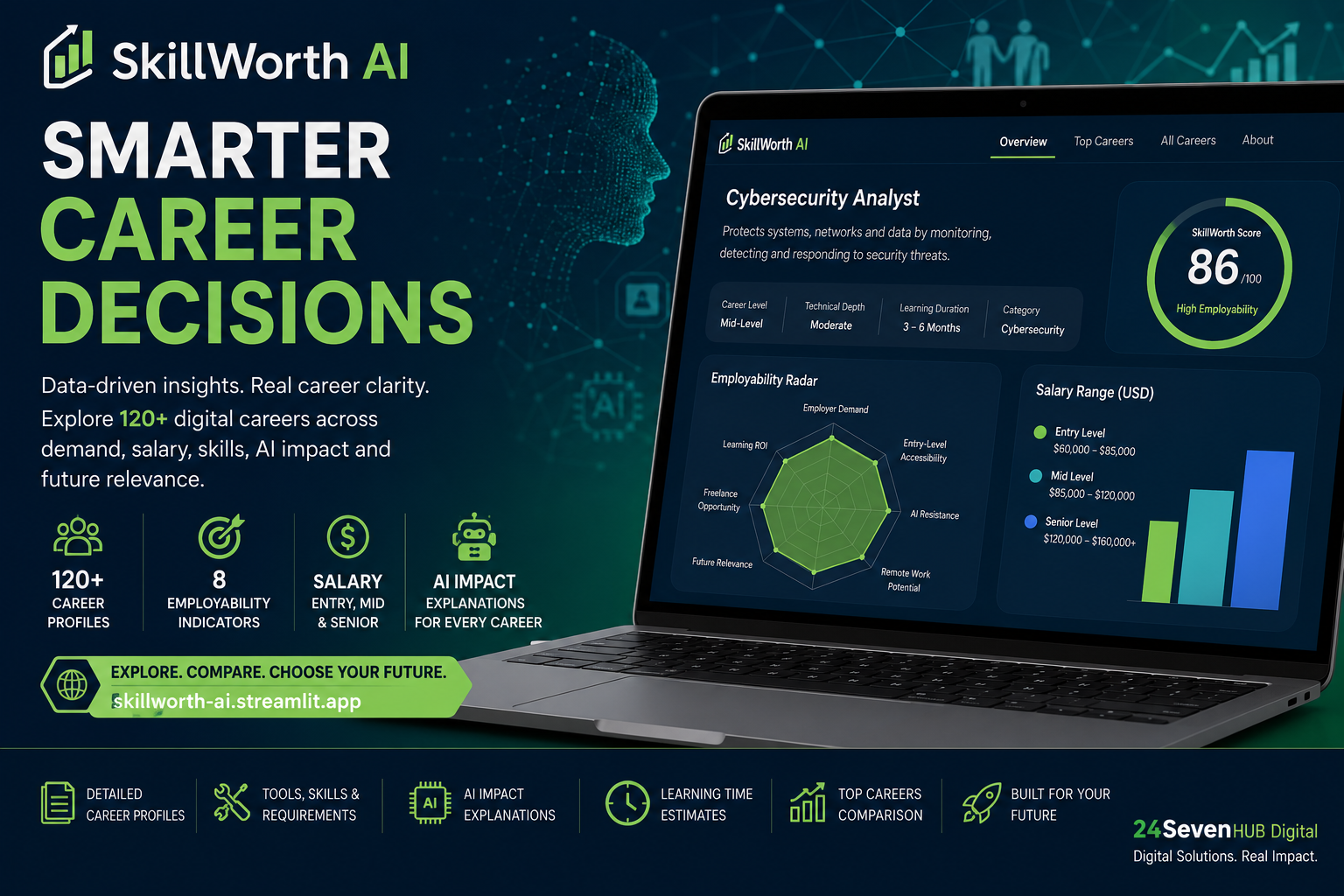
The platform currently provides more than 120 detailed career profiles across technology, business, data, cybersecurity, marketing, finance, design, operations, human resources and other digital fields.
Users can select a career and review its:
- SkillWorth Score
- Employer-demand potential
- Entry-level accessibility
- Remote-work potential
- Freelance opportunity
- Salary potential
- Future relevance
- AI resistance
- Learning return on investment
- Estimated learning duration
- Entry, mid-level and senior salary ranges
- Typical daily responsibilities
- Entry requirements
- Common tools
- Alternative job titles
- Recommended foundation skills
- Complementary skills
- Technical depth
- Career level
- AI-impact explanation
Instead of providing a one-dimensional answer, SkillWorth AI presents a broader view of each career.
The Eight Employability Indicators
SkillWorth AI evaluates careers using eight structured indicators.
1. Employer Demand
This considers the strength of organisational demand for the career or skill.
A career may be interesting and technically valuable, but users also need to understand whether employers are actively building teams around it.
Demand does not guarantee employment, but it provides useful context when comparing opportunities.
2. Entry-Level Accessibility
Not every high-paying career is designed for beginners.
Some roles require years of previous experience, advanced technical knowledge or exposure to production environments. Others provide more accessible entry routes through portfolio projects, certifications, internships or freelance work.
The entry-level indicator helps users understand how realistic the first step may be.
3. Remote-Work Potential
Remote work is an important consideration for professionals who want access to opportunities beyond their immediate location.
Some careers can be performed almost entirely online, while others depend on physical infrastructure, in-person operations or location-specific regulations.
SkillWorth AI considers the degree to which each role supports remote employment.
4. Freelance Opportunity
Not everyone wants a traditional full-time job.
Freelance potential matters to consultants, entrepreneurs, side-hustlers and professionals building independent careers.
Skills such as WordPress development, graphic design, SEO, copywriting and video editing may offer strong freelance opportunities, while other roles may be more commonly found within established organisations.
5. Salary Potential
Salary remains an important part of career planning.
SkillWorth AI provides indicative salary ranges for entry, mid-level and senior professionals. These estimates are presented in United States dollars to create a consistent comparison across career paths.
Actual salaries still depend on location, industry, experience, certifications, employer and negotiation.
6. Future Relevance
A career may be valuable today but vulnerable to technological or economic change.
Future relevance considers whether the role is likely to remain important as organisations adopt cloud computing, automation, data systems, cybersecurity controls and artificial intelligence.
7. AI-Displacement Resistance
Artificial intelligence is changing almost every profession, but it will not affect every career in the same way.
Some jobs contain repetitive tasks that can be automated. Others depend heavily on human judgement, leadership, accountability, relationship-building, physical access, regulatory interpretation or strategic decision-making.
SkillWorth AI helps users understand whether AI is more likely to replace tasks, transform responsibilities or increase productivity within a role.
8. Learning Return on Investment
A career path should be evaluated against the time and effort required to become employable.
Learning return on investment considers whether the likely career opportunities justify the approximate learning duration and complexity.
This is particularly valuable for career changers who must make careful decisions about limited time and financial resources.
Why Salary Alone Is Not Enough
A common mistake is choosing a career based only on its highest advertised salary.
Senior salaries can be attractive, but they do not reveal:
- How long it takes to reach that level
- Whether entry-level roles are available
- How much previous experience is expected
- Whether the work can be performed remotely
- Whether freelance opportunities exist
- How competitive the field is
- How frequently the role appears in different industries
- How artificial intelligence may affect it
A senior cloud architect, security architect or solutions architect may earn an excellent salary, but those are not usually beginner roles.
Meanwhile, a career with a lower maximum salary may offer a faster entry route, more freelance flexibility or a better match for someone’s existing experience.
SkillWorth AI therefore treats salary as one part of a broader decision.
Helping Career Changers Use Transferable Skills
Many people believe that changing careers means starting from zero.
That is rarely completely true.
A digital marketer may already possess:
- Analytical skills
- Campaign reporting experience
- Client communication
- Content strategy
- Business understanding
- Project coordination
- Data interpretation
Those capabilities may transfer into growth marketing, product operations, business analysis, marketing automation, customer success or data analytics.
An administrative professional may already have useful experience in:
- Documentation
- Process management
- Scheduling
- Stakeholder communication
- Record keeping
- Customer support
- Confidential information handling
These strengths may support a transition into project coordination, CRM administration, HR operations, compliance, virtual assistance or business operations.
A good career platform should therefore show not only what a job requires but also the foundation and complementary skills that support progression.
SkillWorth AI includes these connections within its detailed career profiles.
Understanding the Influence of Artificial Intelligence
People commonly ask whether AI will eliminate a particular career.
The more useful question is:
Which tasks within the career will AI automate, and which responsibilities will still require human expertise?
AI may generate basic copy, but strategic copywriters still provide audience understanding, originality and brand direction.
AI may create code, but software engineers remain accountable for architecture, integration, security and production reliability.
AI may assist with cybersecurity monitoring, but security professionals still make risk decisions, investigate incidents and take responsibility for organisational protection.
AI may prepare reports, but business analysts still gather requirements, interpret stakeholder needs and translate problems into practical solutions.
SkillWorth AI gives each career a written AI-impact explanation rather than relying on a simplistic prediction.
ALSO, READ Top 15 Cybersecurity Courses for Beginners to Get Remote Jobs in 2026
Who Can Benefit From SkillWorth AI?
The platform is designed for several groups.
Students
Students can explore different careers before selecting courses, certifications or degree specialisations.
Career Changers
Career changers can compare new opportunities against their experience, available learning time and desired working conditions.
Freelancers
Freelancers can identify skills with strong independent-service potential.
Remote-Job Seekers
Professionals seeking global or remote opportunities can compare careers based on remote-work suitability.
Training Providers
Educators and boot camps can use career profiles to help learners connect training programmes with realistic job outcomes.
Career Coaches
Career advisers can use the structured categories and indicators to support more informed conversations.
Employers and Workforce Organisations
Organisations can use the platform concept to explore emerging skills and communicate career pathways more clearly.
A Career-Exploration Tool, Not a Guarantee
SkillWorth AI is designed to support decisions, not make them on behalf of users.
The current version is an MVP. Its scoring values, salary ranges and learning periods are curated estimates for comparison and product testing.
They are not:
- Employment guarantees
- Salary guarantees
- Live job-market measurements
- Professional financial advice
- Substitutes for personal research
A career decision must also consider personal interests, location, education, financial circumstances, responsibilities, networking opportunities and access to practical experience.
The goal of SkillWorth AI is not to tell everyone to choose the same career.
Its goal is to help each person ask better questions before making an important investment.
The Future of SkillWorth AI
The first version establishes the core career-intelligence system.
Future development may include:
- Live labour-market data
- Country and regional filters
- Location-based salary comparisons
- Industry-adoption scoring
- Entry-level competitiveness scoring
- Personalised career recommendations
- Skill-gap assessments
- Learning-roadmap generation
- Resume-to-career matching
- Certification recommendations
- Career-comparison tools
- Exportable reports
- User accounts and saved careers
- API access
These additions would make the platform increasingly personalised and responsive to changing labour-market conditions.
From Career Confusion to Career Clarity
The digital economy offers extraordinary opportunities, but opportunity without clarity can lead to wasted effort.
People should not have to choose a career because it is trending on social media. They should not invest months in a course without understanding the role it prepares them for. They should not select a skill based only on its highest salary claim.
They deserve to understand:
- What the career involves
- How difficult entry may be
- Which tools are commonly used
- What employers may expect
- How long learning could take
- Whether remote and freelance opportunities exist
- How AI may affect the work
- Which complementary skills increase career value
SkillWorth AI brings these questions together in one structured platform.
It transforms scattered career information into clearer, more comparable intelligence.
Explore SkillWorth AI
SkillWorth AI is now available online.
Explore the platform:
https://skillworth-ai.streamlit.app
GitHub repository:
https://github.com/ThePreacherMan/skillworth-ai
SkillWorth AI was developed by Chigoziem Ibeh under 24SevenHUB Digital.
The mission is simple:
Help people understand the value, requirements and future of a digital career before committing their time, money and energy to learning it.
SkillWorth AI by 24SevenHUB Digital — Digital Skills Intelligence for Smarter Career Decisions.